
Bringing the land back to life
Forest families helped pick the right seeds. Seeds were sown inside thorny bushes so cattle cannot eat them, and scattered by hand so the forest can grow back on its own. Supported by Ankur Seeds and Lasenor India.
Every annual activity report from FY 2020-21 to FY 2024-25, in full. Read the highlights, then open any report page by page.
FY 2024-25
April 2024 to March 2025
The year NiViM organised its work into five pillars: restoring the land, strengthening forest rights, fair income from forest produce, natural farming, and animal welfare.
“Towards a future where community livelihood and forest conservation grow together.”
Forest families helped pick the right seeds. Seeds were sown inside thorny bushes so cattle cannot eat them, and scattered by hand so the forest can grow back on its own. Supported by Ankur Seeds and Lasenor India.
Land cleared of invasive species, pits dug and filled with farmyard manure, then planted by the community in July and August. HDFC Bank supported the plantation and Western Coalfields the fencing and drip irrigation.
Village conservation and management plans prepared, and decisions taken to grow trees on farms and protect local plants and animals, across 9,385 hectares.
Villages sold their leaves through open bidding, with no middlemen. 393,870 bunches were collected, and earnings reached 228 people in 9 villages.
52 farmers moved 90 acres to chemical-free farming with indigenous seeds and Gomay manure, supported by the Bharat Agroecology Fund and Global Greengrants Fund.
The NETRAVAN goshala keeps indigenous cows whose dung and urine become natural manure for the farms.
A plant distribution drive at Laxmi Bhavan Square, Nagpur, on 5 June 2024, with the Regional Officer of the Maharashtra Pollution Control Board.
14 trainings for forest rights committee members, selling forest produce, and skills for women, and farm field school demonstrations, with Lasenor India CSR support.
With: HDFC Bank, Western Coalfields Ltd, Lasenor India, Ankur Seeds, Bharat Agroecology Fund, Global Greengrants Fund
FY 2023-24
April 2023 to March 2024
NiViM worked with 45 Gram Sabhas of 19 Gram Panchayats, about 3,368 households and 40,000 people. Villages began planning their own forests and running rural employment work themselves.
A rally to understand the Aam river visited all 22 villages on its banks, flagged off by the Nagpur Collector, Dr. Vipin Itankar (IAS).
Gram Sabhas prepared forest care plans by mapping their own land and forest, with 600 active committee members taking part directly.
23 tribal women formed a farmer producer company to farm together and cut chemical fertiliser, with Lasenor India CSR support.
Nature lovers plant one sapling for each year of their age at NETRAVAN, at ₹500 a plant, cared for three years. ₹2 lakh was raised for 400 plants.
30 cattle of 5 Indian breeds at NETRAVAN. A ₹1-a-day campaign raised ₹24,386 in three months, including a gift from Dubai.
Open 8 am to 9.30 pm every day at Besa, with a library of 3,000+ books in English, Marathi and Hindi.
With: Lasenor India, Vidarbha Livelihood Forum, Gramayan Pratishthan, Ambuja Foundation, RCOF
FY 2022-23
April 2022 to March 2023
9,885 hectares were allotted to the Gram Sabhas of 45 villages in Umred taluka. NiViM trained the new committees, and 21 of them ran their own tendu leaf business for the first time.
Two batches at NETRAVAN in November 2022 for committee members, forest guards, patwaris and gramsevaks, opened by the SDO and Tahsildar of Umred.
The Umred Taluka Gramsabha Mahasangh, a union of village Gram Sabhas, ran the whole tendu work, from selling to transport. Villages agreed not to cut trees or set forest fires before the season.
Under the Chala Januya Nadila campaign, 15 villages on the Aam river were surveyed with the revenue department.
At Tikhadi in Parsodi Gram Panchayat, the forest rights committee was formed entirely by women.
With: Lasenor India (CSR), Vidarbha Livelihood Forum, Gramayan Pratishthan, Lok Dnyanpith
FY 2021-22
April 2021 to March 2022
On 11 May 2021 the Government of Maharashtra officially declared 96.01 sq km the Muniya Conservation Reserve, a proposal NiViM first made in 2007. NiViM then turned to the villages around it.
Between September 2021 and February 2022, Gram Sabhas formed Community Forest Rights Management Committees with gramsevaks and foresters.
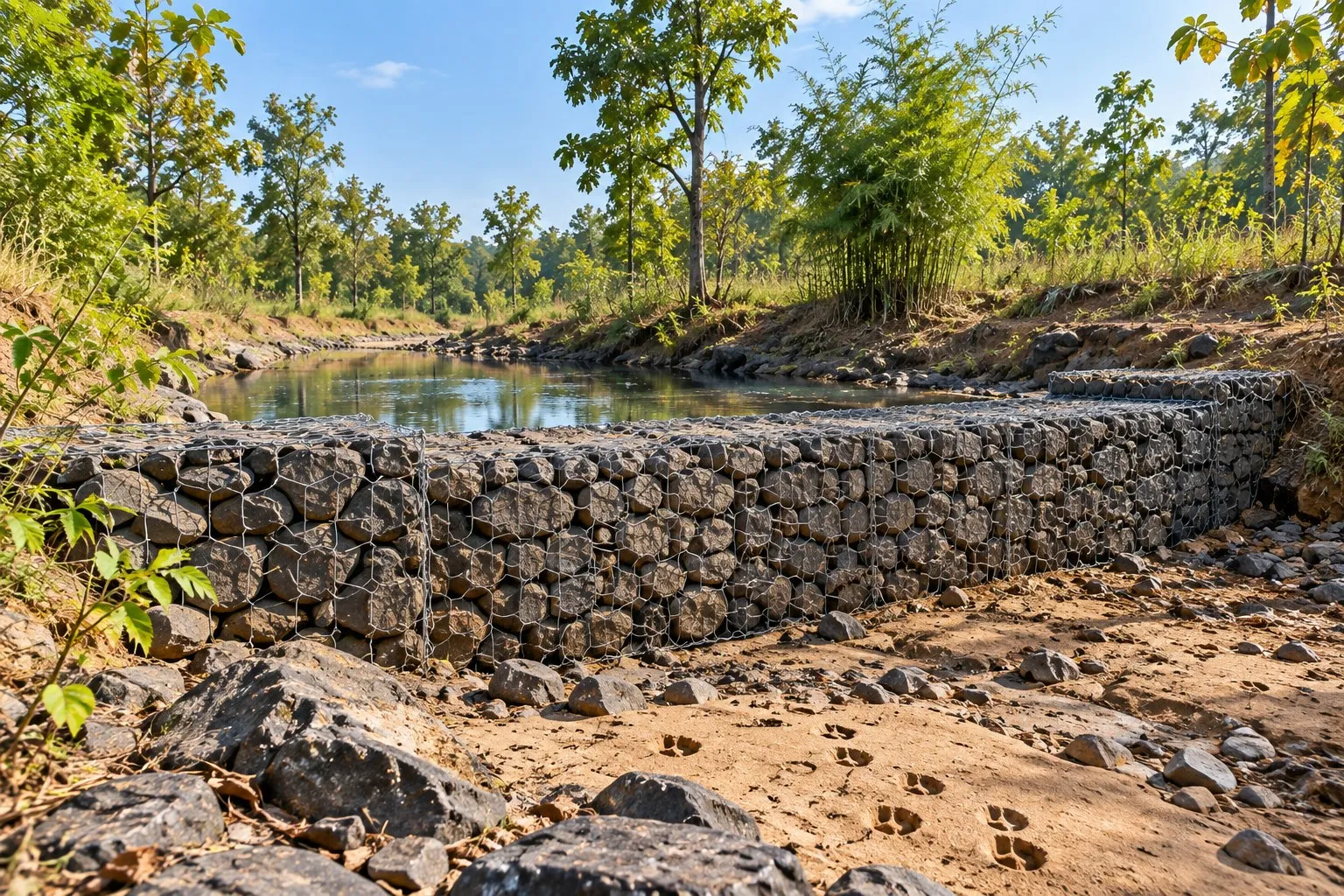
Two cement nala bandhs on the stream from Khapari to Davha, with CSR support from MRG Consultants. Wells in Davha rose and the forest stream held water until the end of April.
The goshala keeps Gavlao, Tharparkar, Kankrej and Gir cattle, and trains farmers and women to make soap, ubtan, dhoop and natural pesticides.
Prof. Vivek Wagh taught children in the tribal village of Jambhlapani every Saturday, and their mothers joined sessions on home study.
With: MRG Consultants (CSR), NABARD, ATMA, Wildlife Trust of India
FY 2020-21
April 2020 to March 2021
COVID-19 stopped most field work and funding nearly dried up. NiViM members kept going with their own money, and on 4 December 2020 the State Wildlife Board approved the Muniya Conservation Reserve.
The State Wildlife Board approved 9,601 hectares, the 9th conservation reserve in Maharashtra and the 3rd in Vidarbha, after work with 30 fringe villages since 2007.
Masks, sanitisers, medicines, pulse oximeters and groceries for villages in Umred and Kuhi, tribal padas near Aarey Colony in Mumbai, and medicine kits for Makardhokda PHC.
Opened at NETRAVAN on 11 October 2020. 98 women from nearby villages made 16 products, sold through self-help groups.
Two gabion bandharas on the Khapari to Davha nala, and a tanker-filled water hole for wildlife in the summer of 2021, with Gramayan Pratishthan.
With: Gramayan Pratishthan, NABARD, ATMA, Umred health and panchayat offices
For over 25 years NiViM has carried out projects with state and central departments. Some of them:
| Department | Project |
|---|---|
| Ministry of Environment & Forests, through BAIF Pune | National Environment Awareness Campaign since 1998: biodiversity, water, solid waste. |
| Ministry of Human Resource Development, New Delhi | Environment Orientation to School Education, and Education in Human Values, in Nagpur schools. |
| MoEF, through the Maharashtra Forest Department | Evaluation of plantations under the National Afforestation Programme in Nagpur, Bhandara and Chandrapur. |
| Water Supply & Sanitation Department (World Bank project) | Jalswaraj: support organisation for 15 Gram Panchayats in Bhandara and 10 in Nagpur district. |
| Healis Sekhsaria Institute of Public Health, Mumbai | Community training and advocacy for tobacco control under COTPA 2003. |
| Maharashtra Pollution Control Board | Pollution Free Maharashtra 2005: a campaign and exhibition for 5,000 students. |
| NABARD | NGO workshop on local environment problems, women's SHGs, and Farmers Clubs for organic farming. |
| Nagpur Municipal Corporation | Lake conservation awareness and action during festivals. |
| DRDA Nagpur | Compost making through self-help groups, and new self-help groups for poor families. |
| Ministry of Drinking Water and Sanitation | Training for Gram Sevaks, Sarpanches and block staff under the Rajiv Gandhi Drinking Water Mission. |
| Social Forestry Department, Nagpur and Bhandara | National Green Corps training and IWDP watershed management. |
| Rural Water Supply Department, Maharashtra | Survey of water availability per person in Tumsar, Lakhani and Bhandara talukas. |
| Animal Husbandry Department | Vaccination, de-worming and treatment of animals, birds and snakes. |
| Wildlife Wing, Forest Department | Awareness and action campaigns for wildlife rescue and conservation. |
| Tribal & Forest Departments, Maharashtra | Solar fencing on farms at the forest fringe to reduce crop raiding by wild animals. |
| Jalyukt Shivar, Government of Maharashtra | Nala deepening and cement nala bandhs to recharge aquifers for farms and wildlife. |
Help us write the next chapter.